

Aluminum is one of the most widely used materials in modern manufacturing. Mastering its precision CNC machining, tight-tolerance milling, and high-speed cutting parameters is far from simple.
For design engineers, manufacturing engineers, and procurement managers, choosing the right aluminum CNC milling service isn’t merely a line item cost, and it isn’t something you can leave up to chance. Selecting the wrong partner can disrupt DFM optimization, APQP/PPAP requirements, and downstream production workflow.
The right partner protects your tolerances, your timeline, and ultimately your product reliability. The wrong vendor introduces risk into every stage of your program.
This engineer’s guide walks you through the critical considerations, from alloy selection and machining strategy to Tier 1 quality systems, so you can confidently evaluate any precision aluminum machining partner.
Why Aluminum Is Both a Top Choice and a Top Challenge
Aluminum brings performance, versatility, and manufacturability to industries from aerospace and defense to powersports and industrial automation.
But it’s also a material that exposes weaknesses in a shop’s tooling strategy, equipment rigidity, thermal management, and process control.
The Benefits
Engineers know the advantages well:
- Excellent strength-to-weight ratio
- High thermal and electrical conductivity
- Natural corrosion resistance
- Easy to finish (anodizing, chem film, powder coat)
These are the reasons aluminum remains a go-to material for custom aluminum components and CNC aluminum parts across the Midwest, including aluminum machining in Wisconsin and other regional manufacturing hubs.
The Machining Challenges
Where this material becomes difficult is in its machinability, especially for tight-tolerance parts.
1. Aluminum Can Be “Gummy”
Lower-grade alloys like 6061 often behave “gummy,” causing built-up edge (BUE) on the cutting tool.
This leads to:
- Poor surface finish
- Dimensional inaccuracy
- Tool chatter and shortened tool life
A shop without the right tooling strategy will struggle.
2. Poor Chip Control
Aluminum’s ductility produces long, stringy chips that wrap around cutters, fixtures, and part features.
Poor chip evacuation can:
- Interrupt cycle times
- Damage surface finishes
- Create safety hazards
- Force operators to babysit the machine
3. High Thermal Expansion
Aluminum grows significantly with heat. The shop must control thermal load through:
- High-pressure coolant
- Aggressive chip evacuation
- Smart toolpathing
- A stable, climate-controlled environment
Otherwise, your part may measure in spec while hot but drift out of spec once cooled.
Not All Alloys Are Created Equal: Matching the Grade to Your Application
A knowledgeable CNC aluminum parts manufacturer doesn’t treat all aluminum alloys the same.
Here’s what engineers should expect their partner to understand and articulate:
6061-T6: The “All-Purpose Workhorse”
- Most accessible, cost-effective alloy
- Excellent for anodizing and weldments
- Good strength and corrosion resistance
Applications: Structural components, housings, consumer products, and prototypes requiring aluminum prototype machining.
7075-T6: The Aerospace & Defense Alloy
- Significantly stronger than 6061
- Zinc-rich alloy with exceptional mechanical properties
- More abrasive to tools (requires an advanced tooling strategy)
- Not weldable
Applications: High-stress aerospace, defense, and powersports components. A favorite for customers requiring 5-axis aluminum milling for structurally complex parts.
2024-T3: The Fatigue-Resistant Alloy
- Copper-alloyed for premium fatigue resistance
- Demands tight process control to avoid corrosion during finishing
Applications: Aircraft fuselage structures, wing skins, and cyclic-load components.
A true partner should guide you toward the right alloy for your mechanical, thermal, and surface-finish requirements.
Key Capabilities for a Precision Aluminum CNC Milling Service
Once you understand the material challenges, the next step is to evaluate whether a shop has the equipment, process control, and engineering depth to overcome them.
High-Speed Machining (HSM) & Tooling Strategy
Aluminum rewards speed.
A qualified shop should have:
- Rigid, high-RPM machining centers (15k – 30k+ RPM)
- High-rake, polished carbide end mills
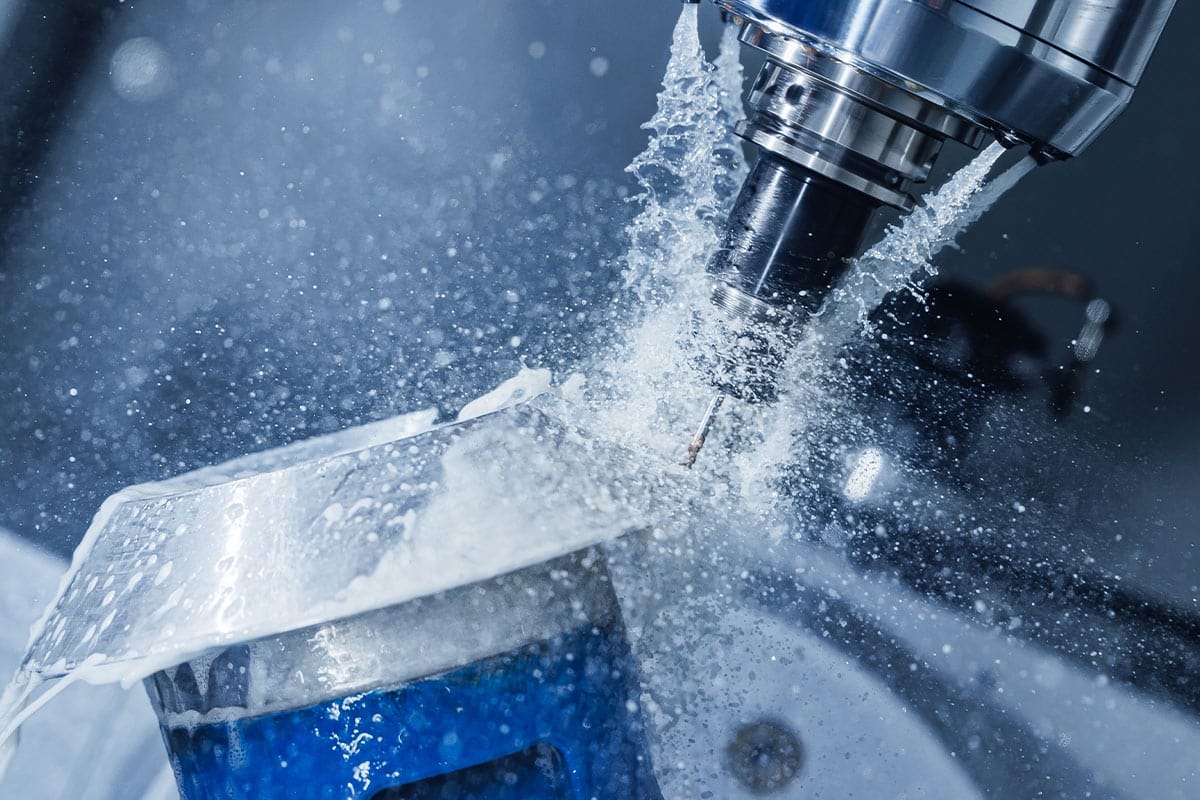
- High-pressure flood coolant or through-spindle coolant
- Toolpath strategies optimized for chip thinning and minimum heat load
The goal is simple: Remove material quickly and cleanly before heat has time to distort the part.
3-Axis vs. 5-Axis Milling for Complex Aluminum Parts
- 3-axis milling: Ideal for simple, prismatic components.
- 5-axis indexed milling: Required for complex geometries, undercuts, and multi-face machining common in aerospace, defense, and powersports.
Why it matters: 5-axis reduces multiple setups, eliminating the cumulative tolerance stack-ups that degrade accuracy.
For true precision, one-and-done machining matters.
Tight-Tolerance & Thermal Management
A top-tier aluminum machining facility should maintain:
- Temperature-controlled machining floors
- High-pressure coolant to stabilize cutting conditions
- Inspection equipment calibrated for aluminum’s thermal behavior
This ensures that a ±0.001” tolerance part holds that tolerance year-round, regardless of season, shift, or operator.
Beyond the Mill: What Separates a “Job Shop” From a Tier 1 Partner
When evaluating a precision aluminum CNC milling service, the real differentiators go beyond machine capability.
This is where you separate low-cost vendors from true Tier 1 suppliers.
Verifiable Quality: Do They Speak APQP/PPAP?
Any shop can claim quality. Very few can prove it.
A Tier 1 CNC partner should demonstrate:
- APQP methodology for project launch
- Full PPAP documentation when required
- Engineering change control
- Traceability from raw material to delivery
- CMM inspection and advanced metrology
If they can’t speak OEM-quality language, they aren’t a Tier 1 partner.
Integrated Finishing & Assembly Services
The machined part is rarely the final part.
A legitimate partner should manage, or directly provide, critical finishing processes:
- Anodizing (Type II & Type III Hardcoat)
- Chem Film/Alodine
- Passivation
- Surface blasting and polishing
- Paint or powder coat (when applicable)
For engineers juggling timelines, having one partner handle machining, finishing, and light assembly reduces:
- Lead time
- Quality risks
- Supplier management
- Variation between finishing vendors
Full Lifecycle Scalability: From Prototype to Production
Your partner should scale with you.
- Support for R&D prototypes
- Rapid iteration for design refinement
- Process standardization for repeatability
- Production scalability for long-term programs
Too often, small shops excel at prototypes but can’t sustain production. Large shops prefer volume and deprioritize custom development. The ideal partner does both consistently.
Don’t Just Buy a Part; Invest in a Partner
Selecting an aluminum CNC milling service is not a commodity decision. It’s a strategic engineering choice that affects every downstream variable: quality, cost, reliability, and risk.
A true partner brings:
- Deep material expertise (from 6061 to 7075 and 2024)
- Advanced machining capability (especially 5-axis aluminum milling)
- Tier 1 quality systems (APQP/PPAP, full inspection capability)
- Integrated finishing and assembly
- End-to-end lifecycle support
- A proven track record in aerospace, defense, industrial, and powersports machining
If you’re looking for a CNC aluminum parts manufacturer with the capabilities, quality, and engineering rigor needed for tight-tolerance work, ACI Industries is built for exactly that.
Ready to elevate your aluminum machining program?
Explore our CNC milling capabilities.