

In 2026, the aerospace and defense supply chain isn’t limited by design capability; it’s limited by manufacturability. Engineers are specifying Titanium (Ti-6Al-4V) and Inconel 718 for everything from drone bodies to hydraulic manifolds.
Titanium and Inconel are often grouped under the label of “exotic alloys,” but treating them as interchangeable is a costly mistake. While both alloys challenge CNC machining, they destroy cutting tools in fundamentally different ways: Titanium through heat concentration and adhesion, and Inconel through rapid work hardening and notch wear. For defense OEMs and aerospace primes, success is no longer defined by whether a shop can machine these alloys, but whether the process can be industrialized, automated, and repeated at scale.
This guide breaks down the physics behind Titanium vs. Inconel machining challenges and explains how ACI Industries engineers stable, lights-out capable processes for materials that many shops still struggle to run manually.
The Physics of Failure: Heat vs. Hardness
At the core of every machining problem is physics. Titanium and Inconel fail cutting tools for opposite reasons, which is why automation strategies that work for one often fail catastrophically for the other.
| Challenge Area | Titanium (Ti-6Al-4V) | Inconel 718 |
| Primary Enemy | Heat concentration (low thermal conductivity) | Work hardening (austenitic matrix) |
| Machining Risk | Fire hazard (pyrophoric chips) | Notch wear and sudden tool death |
| Machine Requirement | High RPM, agile 5-axis systems | High torque, mass damping |
| Coolant Strategy | High-pressure (1000 PSI+) | High concentration (10–12%) |
| Lights-Out Viability | High risk (fire suppression required) | Medium risk (redundant tooling required) |
In contrast, Inconel retains mechanical strength at elevated temperatures and resists plastic deformation, forcing tools to plow rather than shear material away cleanly.
These opposing physical behaviors dictate everything from machine selection and tooling to coolant strategy and automation risk.
Titanium (Ti-6Al-4V): The Heat Trap
The Science
Titanium’s most punishing machining characteristic is its very low thermal conductivity, measured at approximately 6.7 W/m-K, compared to aluminum’s ~205 W/m-K. This property prevents heat from escaping the cutting zone, concentrating thermal energy directly at the tool edge.
The Result
During cutting, heat does not evacuate through the chip. Instead, it concentrates at the cutting edge. As temperatures climb, titanium becomes chemically reactive.
The Failure Mode
This leads to galling, where the material adheres to the cutting edge and tears away tool coating and substrate. Once adhesion begins, tool failure accelerates rapidly. Compounding the issue, fine titanium chips can be pyrophoric under certain machining conditions, creating a fire risk, particularly in unattended operations.
This is why aerospace CNC machining titanium is less about horsepower and more about thermal management and chip evacuation.
Inconel 718: The Shield Wall
The Science
Inconel 718 retains mechanical strength at temperatures exceeding 1,300°F. Its nickel-based crystalline structure resists slip, meaning the material does not shear cleanly under a cutting edge.
The Result
Rather than cutting cleanly, Inconel deforms plastically. If the tool rubs instead of cuts—even for a fraction of a second—the surface instantly hardens, becoming harder than the cutting edge itself. This results in rapid notch wear at the depth-of-cut line, followed by sudden and unpredictable tool failure.
The Failure Mode
This leads to notch wear at the depth-of-cut line. The insert edge erodes rapidly until catastrophic failure occurs, often without warning. This unpredictability makes lights-out machining of Inconel 718 especially challenging for shops without advanced process monitoring.
Advanced Machining Strategies: The “How-To”
This is where Tier 1 capability separates from job-shop experimentation. Automating superalloy machining requires strategies built around physics, not trial and error.
Titanium Strategy: High-Pressure Chip Control
The key to titanium is breaking the vapor barrier that forms at the cutting edge.
- High-Pressure Coolant (1000 PSI+)
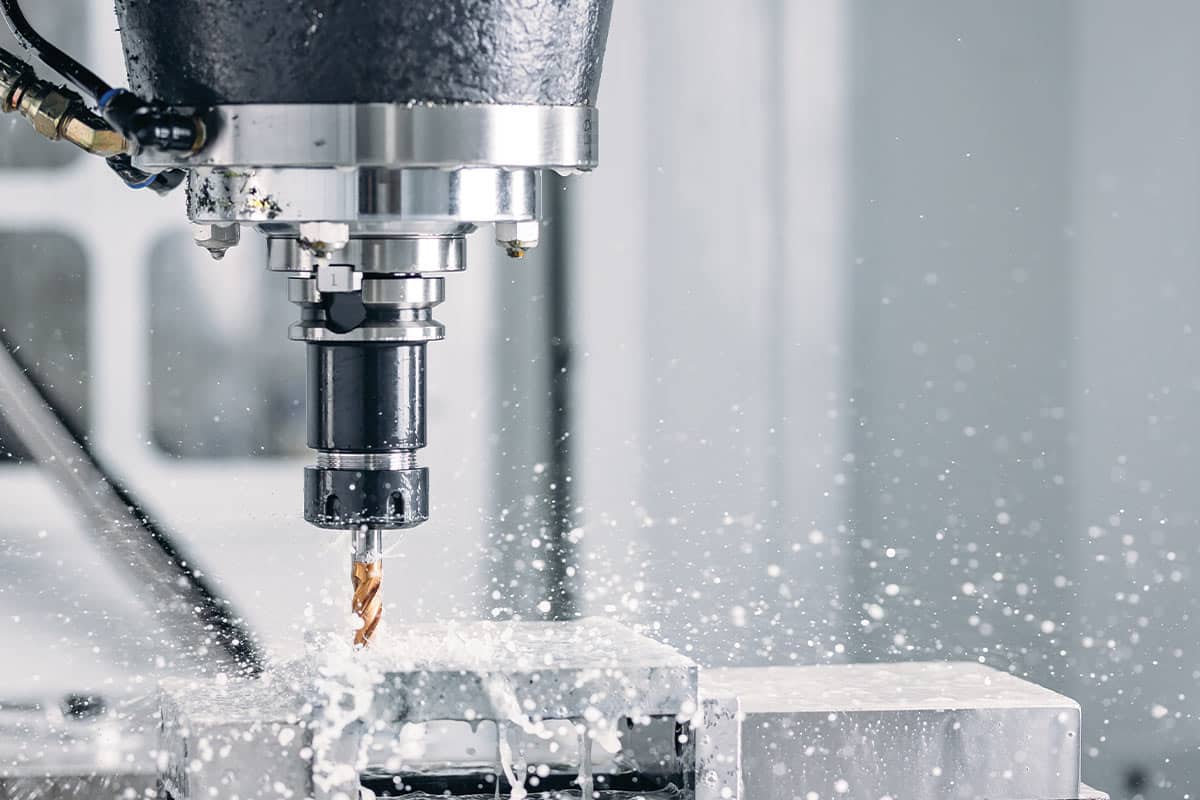
Flood coolant is insufficient. High-pressure coolant jets physically blast heat away from the tool, preventing chemical adhesion and galling. - Radial Chip Thinning Toolpaths
Light radial engagement with deep axial cuts keeps heat generation predictable while maintaining metal removal rates. - 5-Axis Rigidity & Workholding
Titanium’s low modulus of elasticity makes it “springy.” Without rigid fixturing and continuous 5-axis engagement, vibration accelerates tool failure.
This approach enables complex aerospace and defense components to be machined in fewer setups with higher consistency.
Inconel Strategy: The “Never Dwell” Rule
In Inconel machining, hesitation is fatal.
- Commitment to Feed Rate
Any slowdown causes rubbing, instant work hardening, and insert destruction. - Tooling Stack Strategy
Ceramic (SiAlON) inserts are used for aggressive roughing, intentionally leveraging heat to plasticize the material. Carbide tooling then finishes below the hardened layer. - Aggressive Engagement Below the Skin
Cuts must get under the work-hardened surface in one pass; light skimming passes guarantee failure.
This discipline is essential for defense programs where process stability matters as much as tolerance.
The Automation Gap: Lights-Out Risks & Solutions
Most shops talk about automation. Few talk about the risks because most are not equipped to manage them.
Titanium presents a fire hazard in unattended machining environments due to combustible fines and elevated cutting temperatures. Safe automation requires engineered chip evacuation, in-machine fire suppression, and validated cutting parameters before lights-out production is attempted.
Inconel presents a different automation risk. Tool failure is often sudden and non-linear, making it difficult to detect without real-time feedback. Machining guides consistently note the need for spindle load monitoring and redundant tooling to mitigate unpredictable tool death in automated environments.
The Tier 1 Difference
Material science and machining literature consistently reinforce that titanium and Inconel, while often grouped together, demand fundamentally different tooling, cutting strategies, and automation safeguards.
For aerospace and defense programs, machining success is no longer about whether a part can be made—it’s about whether it can be made repeatably, safely, and at scale. That requires more than machines. It requires a deep understanding of physics, chemistry, and risk management across the entire manufacturing process.
ACI Industries isn’t just a CNC machine shop. We are a U.S.-based aerospace and defense supply chain partner focused on eliminating manufacturability risk before it reaches your production schedule.
Don’t let exotic alloys become the bottleneck in your 2026 production plan.