

The Shift to Intelligent Manufacturing Ecosystems
In 2026, the industrial divide is no longer defined by cost, but by capability. Specifically, the gap between manufacturers relying on traditional 3-axis machining and those leveraging full 5-axis simultaneous milling continues to widen.
As the global CNC milling market accelerates toward a projected valuation exceeding $120 billion by 2035, the driving force is clear: demand for high-complexity components across aerospace, electric vehicles (EVs), and advanced medical devices. These industries require geometries that simply cannot be achieved efficiently, or at all, using legacy machining strategies.
The modern shop is no longer just a production floor. It’s an intelligent ecosystem, integrating advanced kinematics, AI-driven toolpaths, real-time simulation, and digital metrology. At the center of this evolution is simultaneous 5-axis milling, not just as a speed advantage, but as a foundational strategy for achieving done-in-one machining reliability.
The Kinematics of Simultaneous Milling vs. 3+2 Machining
To understand the leap forward, it’s critical to distinguish between 3+2 (positional) machining and true simultaneous 5-axis motion.
In 3+2 machining, the part is indexed into a fixed orientation using two rotational axes, and then cutting occurs along the traditional X, Y, and Z axes. While effective for certain geometries, this method locks the part in place during cutting, limiting flexibility.
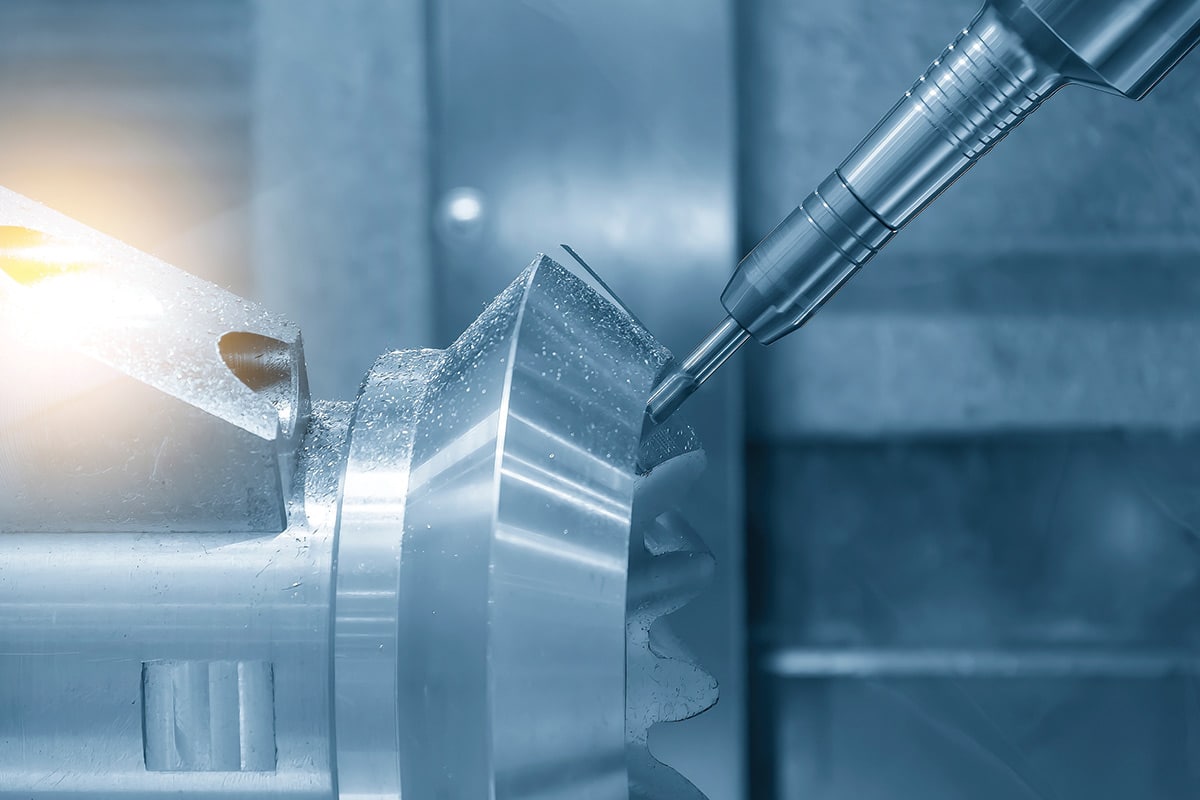
Simultaneous 5-axis milling, by contrast, involves continuous, synchronized movement across all five axes: X, Y, Z, A, and C. This creates a dynamic cutting environment where the tool maintains a constant optimal angle relative to the workpiece surface.
Why does this matter?
- Improved Surface Quality: Continuous tool engagement reduces scalloping and tool marks on complex, contoured surfaces.
- Reduced Tool Pressure: Maintaining optimal angles distributes cutting forces more evenly, extending tool life.
- Higher Material Removal Rates (MRR): Efficient engagement enables more aggressive cutting without compromising stability.
For warped surfaces, organic shapes, and undercuts, common in aerospace CNC milling and EV components, this synchronized motion is essential.
The “Done-in-One” Advantage: Eliminating Setups and Stack-Up Errors
Every time a part is removed and re-fixtured, it introduces the potential for stack-up error, meaning small positional inaccuracies that accumulate across setups. In high-precision industries, even microns matter.
ACI Industries’ approach centers on done-in-one machining, where a part is completed in a single setup. This eliminates the need for multiple fixtures and preserves a consistent coordinate reference throughout the machining process.
The result?
- Tolerances as tight as ±0.005 mm
- Reduced inspection and rework cycles
- Faster lead times with fewer manual interventions
This is the key to scaling high-complexity components without introducing quality drift. In a production environment where consistency is non-negotiable, eliminating human-dependent repositioning is a strategic advantage.
Technical Spotlight: Machining Impellers and Manifolds
Few components better demonstrate the power of 5-axis simultaneous milling than impellers and manifolds.
Impellers, commonly used in aerospace and energy systems, feature deep, narrow channels and twisted blades with continuously changing curvature. Traditional machining methods struggle with:
- Limited tool access
- Collision risks
- Inconsistent surface finishes
With simultaneous 5-axis motion, tapered ball-nose cutters can navigate these complex geometries with precision. The tool continuously reorients to maintain proper engagement, avoiding collisions while delivering a mirror-like surface finish.
Similarly, manifolds with internal channels and intersecting passages benefit from full-axis motion, enabling complex internal geometries to be machined without splitting the part into multiple components.
This capability is central to done-in-one machining, as it reduces assembly requirements while improving structural integrity.
Material Science: Managing Thermal Loads in Advanced Alloys
Modern manufacturing increasingly relies on advanced materials like Titanium (Ti-6Al-4V) and Inconel 718, both known for their strength, corrosion resistance, and heat tolerance.
However, these materials present unique machining challenges.
Titanium, for example, has low thermal conductivity, meaning heat generated during cutting remains concentrated at the tool edge. This can lead to:
- Rapid tool wear
- Work hardening
- Surface integrity issues
To mitigate these effects, ACI integrates:
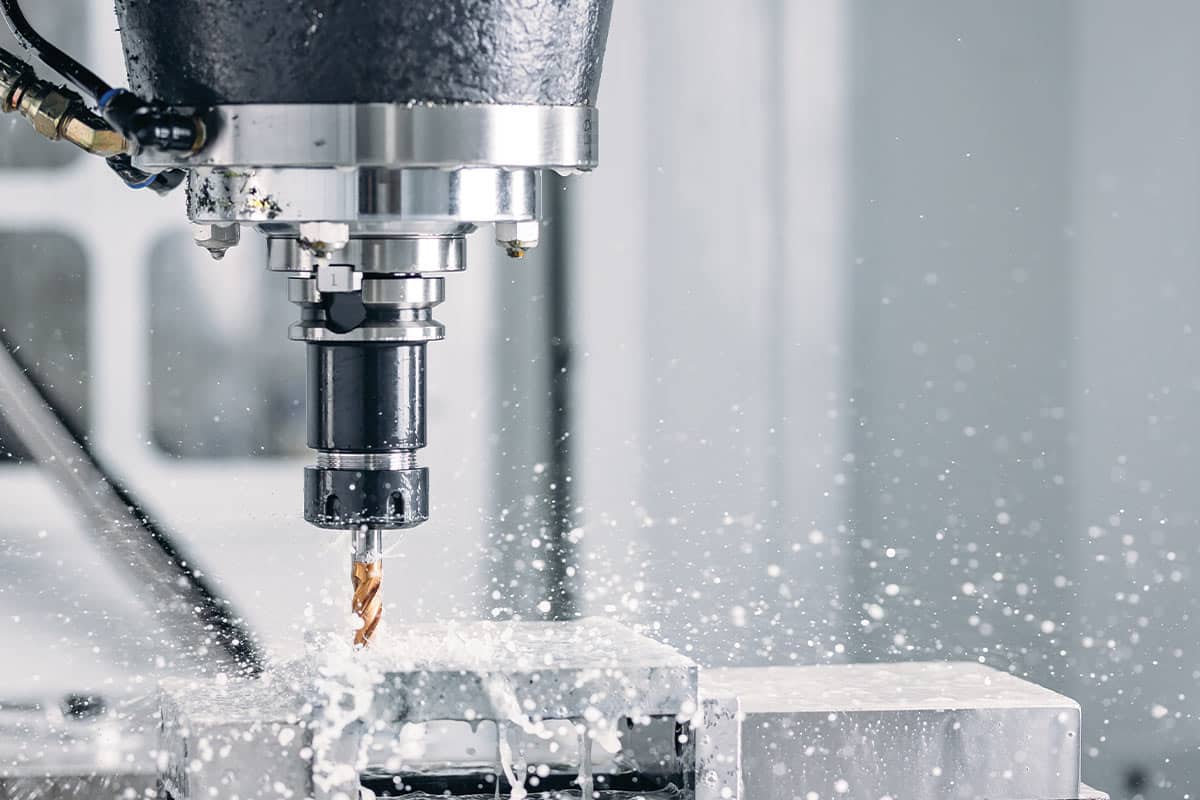
- High-pressure coolant systems to dissipate heat at the cutting interface
- Dynamic toolpaths that maintain constant engagement, preventing tool “dwelling”
- Optimized feed rates and cutting strategies tailored to each alloy
Simultaneous 5-axis motion plays a critical role here as well, allowing for smoother tool engagement and reducing localized heat buildup.
The Software Brain: RTCP and AI-Driven Toolpath Optimization
Behind every successful 5-axis operation is a sophisticated control system.
One of the most critical technologies is Rotational Tool Center Point (RTCP), also known as Tool Center Point Control (TCPC). This function ensures that the tool tip remains in the correct position relative to the workpiece, even as the machine’s rotational axes move.
Without RTCP, the tool tip would “wander” during rotation, leading to inaccuracies and potential collisions.
In 2026, the evolution doesn’t stop there. Advanced CAM software now incorporates AI-driven toolpath optimization, enabling:
- Real-time simulation of machining processes
- Automatic detection of potential tool collisions (“clashes”)
- Optimization of cutting strategies for efficiency and tool longevity
This predictive capability transforms machining from a reactive process into a proactive, data-driven system, reducing trial-and-error on the shop floor.
Metrology in the Digital Thread: Blue Light Scanning vs. CMM
Precision machining doesn’t end when the spindle stops. Verification is a critical part of the process.
Traditional Coordinate Measuring Machines (CMMs) remain the gold standard for measuring discrete features like hole locations and critical dimensions with micron-level accuracy.
However, for complex, organic geometries, Blue Light 3D Scanning offers a powerful complement.
Using a 450nm wavelength, blue light scanners provide:
- High-resolution surface mapping
- Reduced interference from ambient light
- Superior performance on reflective machined metals
Unlike traditional scanning methods, blue light technology often eliminates the need for surface sprays, streamlining the inspection process.
By integrating both CMM and blue light scanning into a unified digital thread, ACI ensures comprehensive validation from critical tolerances to full-surface analysis.
DFM for 5-Axis: Strategies to Slash Production Costs
Design for Manufacturability (DFM) is often associated with simpler machining processes, but it’s equally critical in 5-axis environments.
Here are key strategies to optimize your designs for 5-axis simultaneous milling:
1. Internal Radii
Maintain internal radii at least one-third of the cavity depth. This allows for more rigid tooling, reducing vibration and improving surface finish.
2. Cavity Depth
Limit cavity depth to 4 times the tool diameter. Exceeding this ratio significantly increases machining complexity, tool deflection, and cost.
3. Wall Thickness
For metal components, maintain a minimum wall thickness of 0.8 mm. Thinner walls are prone to vibration and “spring-back,” compromising dimensional accuracy.
4. Avoid Unnecessary Complexity
While 5-axis machining enables complex geometries, not all complexity is beneficial. Strategic simplification can reduce machining time without sacrificing functionality.
By incorporating these principles early in the design phase, engineers can significantly reduce production costs while maintaining performance requirements.
Partnering with ACI’s Wisconsin Fleet
Simultaneous 5-axis milling has evolved from a competitive advantage to a baseline requirement for modern manufacturing.
At ACI Industries, this capability is supported by a specialized fleet designed for performance and scalability, including:
- Brother Speedio M140X1 for high-speed, multi-tasking operations
- Brother Speedio S1000X1 for efficient machining of larger workpieces
Located in Wisconsin, ACI’s facility integrates advanced machining, intelligent software systems, and precision metrology into a unified workflow to deliver consistent results across even the most demanding applications.
For engineers and procurement leaders, the takeaway is simple:
Don’t just source a part. Source a strategy for geometric perfection.
Ready to get started? Contact us today!