

The Engineering Behind Every Trigger Pull
Every trigger pull is a moment of trust—where split-second performance depends on precision engineering measured in microns.
Beneath the surface, a seamless chain of components must cycle flawlessly, guided by firearms component tolerances so tight that even a 0.001-inch deviation can mean the difference between smooth operation and failure.
Traditional machining methods struggle to keep pace with modern firearm design, where lightweight materials, complex geometries, and zero-margin reliability are the standard. Basic processes lack the consistency required to meet today’s demands for high-performance systems.
That’s where CNC firearms manufacturing sets the benchmark. Let’s take a look at how leveraging precision and automation with CNC technology delivers repeated reliability at scale to power the next generation of American-made firearm components.
The Pillar of Precision: Why Microns Matter in High-Pressure Systems
In firearms manufacturing, precision and repeatability are complementary pillars of performance.
- Precision refers to how accurately a part meets its intended design specification. In this industry, tolerances are typically ±0.001” to ±0.005”.
- Repeatability ensures that the 1,000th component produced is identical to the first, eliminating variability that could compromise safety or performance.
The relationship between these two concepts can be understood through the idea of a functional sweet spot.
If tolerances are too tight, components may bind under thermal expansion or fouling. If tolerances are too loose, the result can be excessive play, reduced accuracy, or failure to cycle correctly.
CNC machining enables manufacturers to consistently hit this equilibrium—where parts move freely, lock securely, and perform reliably under stress.
Even a deviation as small as 0.001 inch can be the difference between a smooth magazine release and a jammed system. In high-pressure environments where forces are amplified, that margin becomes critical.
This is where advanced CNC machining and tuning excels, delivering not only exact dimensions but consistent outcomes across production runs.
Precision vs. Repeatability in Firearms Manufacturing
| Category | Precision | Repeatability | Why It Matters |
| Definition | Meets exact design specs (±0.001”–±0.005”) | Produces identical parts at scale | Ensures safe, reliable operation |
| Performance | Controls fit, alignment, and function | Ensures consistent cycling and feel | Prevents variability and malfunctions |
| Tolerance Balance | Defines ideal “sweet spot” | Maintains balance across production | Too tight = binding; too loose = inaccuracy |
| CNC Advantage | Delivers micron-level accuracy | Enables repeatable output at scale | Achieves precision and consistency together |
| Validation & Result | Verified via CMM, GD&T | Controlled via SPC | Consistent, high-performance components |
Critical Components: Where CNC Makes the Difference
The impact of CNC precision becomes most apparent when examining the core components of a firearm.
Receivers & Slides: Eliminating Stack-Up Error
Receivers and slides feature complex geometries—internal pockets, rail systems, and angular cuts that must align perfectly.
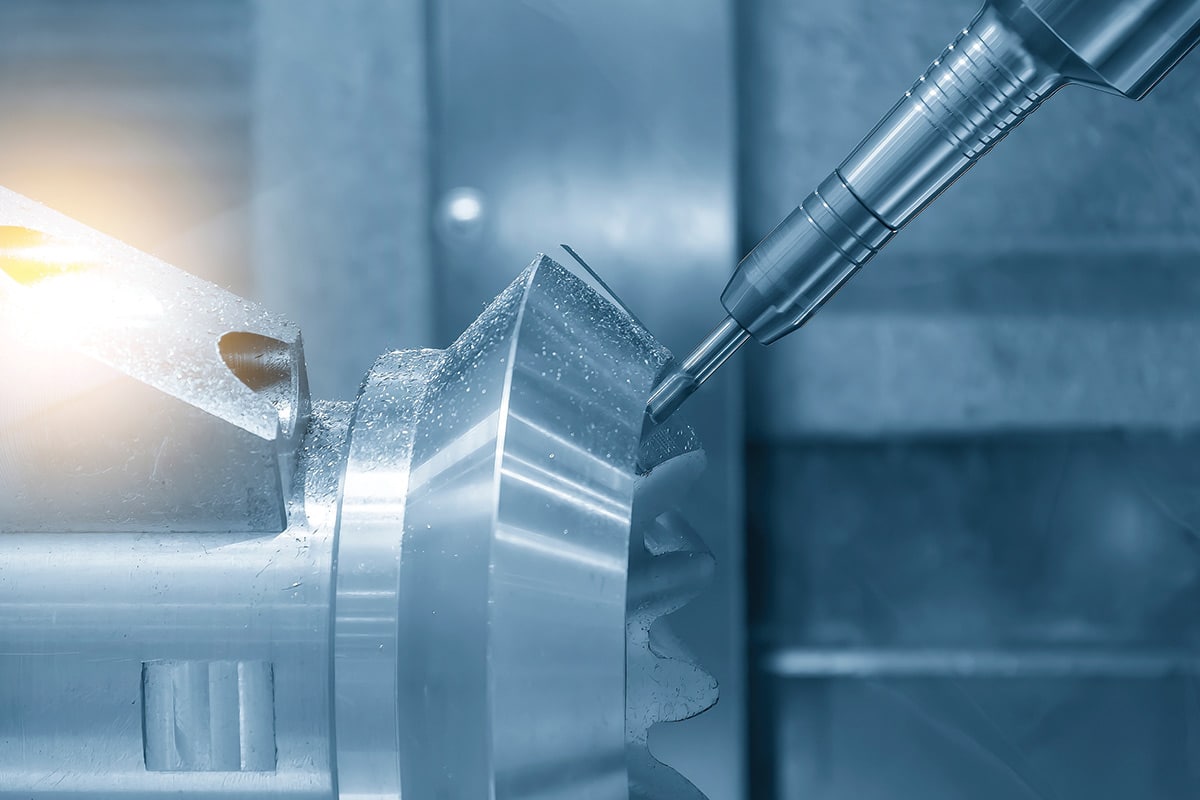
With 4-axis and 5-axis machining, these features can be completed in a single setup. This eliminates “stack-up error,” which occurs when multiple setups introduce slight misalignments that compound across operations.
By reducing repositioning, manufacturers achieve:
- Greater dimensional accuracy
- Improved surface finishes
- Reduced cycle times
This level of integration is essential for producing high-performance components at scale.
Barrels & Bolts: The Importance of Rotational Symmetry
Barrels and bolts demand near-perfect concentricity. The bore, chamber, and threading must align precisely along a single axis to ensure consistent ballistic performance and safe operation.
This requirement is often described as rotational symmetry, where every feature is perfectly centered around the same axis of rotation.
Modern multi-tasking CNC turning centers allow manufacturers to:
- Machine the bore and external features in one continuous process
- Maintain alignment between critical surfaces
- Reduce cumulative tolerance errors
The result is improved accuracy, reduced wear, and enhanced reliability over the lifecycle of the firearm.
Firing Pins & Triggers: Micro-Precision with Swiss Machining
Some of the most critical components are also the smallest. Firing pins, trigger components, and springs require extreme precision despite their slender geometries.
This is where Swiss-style machining becomes indispensable.
Using guide-bushing support, Swiss machines stabilize long, narrow parts during machining, preventing deflection and maintaining ultra-tight tolerances—often as precise as ±0.0002 inch.
For these components, even microscopic inconsistencies can lead to:
- Misfires
- Inconsistent trigger pull
- Premature wear
Swiss machining ensures that every part performs exactly as intended, every time.
Material Science: Machining the “Unmachinable”
Modern firearms manufacturing is no longer limited to traditional steels. Today’s designs demand advanced materials that offer strength, weight reduction, and corrosion resistance.
Common materials include:
- Titanium (Ti-6Al-4V) for strength-to-weight optimization
- 7075-T6 Aluminum for lightweight structural components
- 17-4 PH Stainless Steel for durability and corrosion resistance
However, these materials introduce new challenges.
Titanium, for example, is a poor conductor of heat. During machining, heat concentrates at the cutting edge, leading to rapid tool wear, deformation, and potential part failure.
To overcome this, advanced CNC environments employ:
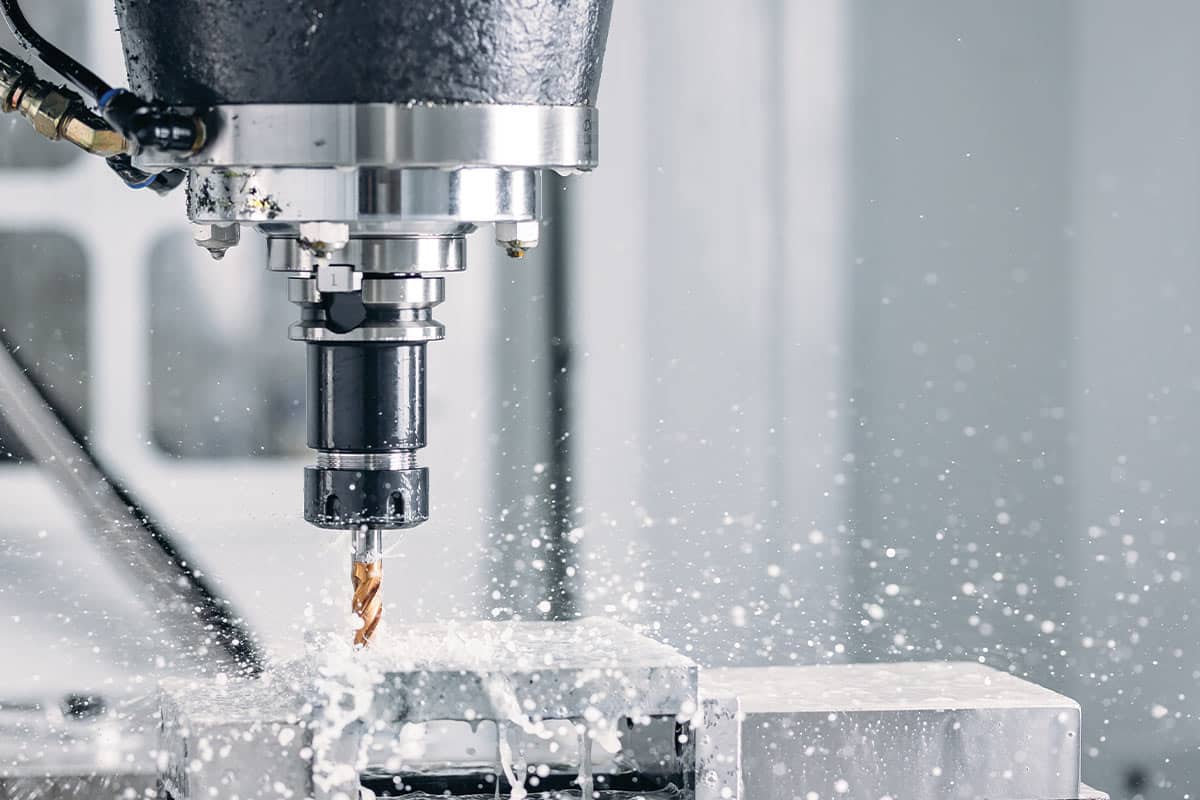
- High-pressure coolant systems (up to 1000 PSI)
- Specialized cutting tool coatings
- Optimized toolpaths to reduce heat buildup
Additionally, controlling phenomena like work-hardening, where material becomes harder during machining, is critical to maintaining consistency and avoiding tool breakage.
These capabilities are what separate standard machining operations from true high-performance manufacturing environments.
The 2026 Horizon: AI, Robotics, and Hybrid Production
The next evolution of CNC firearms manufacturing is already underway, driven by automation, artificial intelligence, and integrated production systems.
AI-Native Machining
In 2026, machining is adaptive.
Modern CNC systems utilize real-time sensor feedback to monitor:
- Vibration
- Tool wear
- Temperature
Using this data, machines automatically adjust feeds and speeds mid-process to maintain optimal cutting conditions.
Additionally, advanced simulation software allows manufacturers to:
- Virtually test toolpaths before production
- Eliminate collisions and errors
- Optimize efficiency without risking material waste
This “digital twin” approach ensures that the first physical part is already production-ready.
Lights-Out Automation
Automation is redefining production efficiency.
With robotic load/unload systems and bar feeders, manufacturers can run lights-out operations, producing parts 24/7 without human intervention.
Benefits include:
- Increased throughput
- Reduced labor costs
- Consistent production quality
For U.S.-based manufacturers, this is a critical advantage. It allows American-made machining services to remain competitive with offshore production while maintaining higher quality standards and faster lead times.
Hybrid Manufacturing
Hybrid manufacturing combines the strengths of additive and subtractive processes.
In firearms manufacturing, this may involve:
- 3D printing complex internal geometries
- CNC finishing critical surfaces for precision and strength
This approach enables:
- Weight optimization
- Design flexibility
- Reduced material waste
While still emerging, hybrid workflows are expected to play a growing role in next-generation firearm design.
Strategic Sourcing: The ACI Advantage
As manufacturing complexity increases, OEM procurement strategies are shifting.
Global supply chains, once favored for cost savings, are now viewed as risk factors, introducing delays, quality inconsistencies, and a lack of traceability.
As a result, many manufacturers are turning to U.S.-based Tier 1 suppliers like ACI Industries.
Traceability as a Standard
In 2026, quality is about documentation, not just inspection.
Every component must be traceable, including:
- Material heat lot
- Machining parameters
- Inspection results
This digital record ensures accountability, compliance, and rapid issue resolution when needed.
Advanced Equipment for Modern Demands
ACI Industries leverages a fleet of high-performance CNC equipment, including:
- Brother Speedio high-speed machining centers
- Tsugami multi-axis platforms
These systems enable:
- Complex multi-axis machining for firearms
- Reduced setup times
- High-volume, high-precision production
Combined with expertise in DFM for firearms, ACI works collaboratively with engineers to optimize designs for manufacturability—reducing costs while improving performance.
For manufacturers seeking reliable, scalable production, this level of capability is essential.
Precision as the Silent Partner
Precision machining is the silent partner behind every successful shot.
It reduces malfunctions, extends component lifespan, and builds confidence in the end user. In an industry where failure is not an option, CNC precision and repeatability are not just advantages; they are requirements.
Looking ahead, the future of firearms manufacturing will not be defined solely by new designs, but by the technologies used to produce them. AI-driven machining, automation, and hybrid production methods are setting a new standard for performance and reliability.
For engineers and procurement teams, the path forward is clear: partner with manufacturers who understand not only how to machine parts, but how to optimize them from the start.
Ready to future-proof your next build?
Collaborate with ACI Industries on design for manufacturability (DFM) and discover how precision CNC machining can elevate your next generation of components.